Words of Wisdom

“One travels more usefully when alone, because he reflects more” - Thomas Jefferson
Showing posts with label mineral. Show all posts

Friday, July 30, 2010

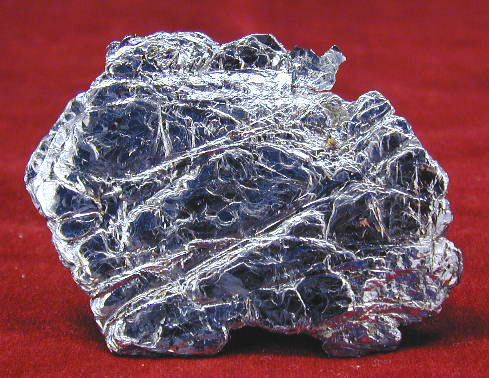
Get to know a Mineral: Molybdenite

About a week ago, I happened upon a new mineral on the property I am working on. We were cutting channel samples when a purplish liquid ran out of the rock cut and upon further inspection, I found silverish goo in the rock. I did not know it at the time, but we had found Molybdenite. So I decided to make it the topic of today's entry.

Molybdenite or "Molly" (as it is affectionately called by geologists) is a soft metallic mineral that is often confused with graphite. In fact, the two minerals can appear so similar that their streaks are often the only way to tell the difference. And if that fails, then it falls to the comparison of density, molybdenite being the denser of the two.

The chemical formula of "Molly" is MoS, and because of its layered structure it has a lubricating effect. Consisting of a sheet of molybdenum atoms squeezed between sheets of sulfur atoms, the atomic structure of molybdenite balances strong Mo-S bonds with weak sulfur bonds between layers. This results in effortless slippage and cleavage planes.

Occurring in high temperature hydrothermal ore deposits, molybdenite is associated with pyrite, quartz and fluorite (to name a few). The element rhenium readily substitutes for molybdenum which can result in a varying structure. Tracing the radioactive isotope rhenium-187 and the daughter isotope osmium-187 allows for geo-chronolgic dating, which is useful for determining dates of deposition and origin.

The main element in "molly" is Molybdenum (Mo) and it has a rather interesting history. It previously held the name molybdena and was often confused with both graphite and galena. It was thought that it contained lead and that is where it gets its name, molybdos (ancient Greek for lead). It was only in 1778 that it was discovered to be its own element and three years later it was successfully isolated using carbon and linseed oil. Reportedly, the alloying of molybdenum with steel was found to occur in one 14th century Japanese sword. Unfortunately, this art was never used widely and was subsequently lost (hence the lack of molybdenum-sword wielding ninjas).

Obviously not Molly...
In World War I, the British replaced the manganese steel plating on their tanks with molybdenum steel plating, which allowed for higher speed, increased maneuverability and greater protection (despite being thinner). Current uses for molybdenum include being used as an adhesive between enamels and metals, as a fertilizer for some plants (including cauliflower) and in biological staining procedures.

Listed on the London Metal Exchange, molybdenum has a value of about $30,000/tonne (as of August 2009). Due to increased demand, it reached a peak of $103,000/tonne in June of 2005! It is the 54th most abundant element in the crust of the Earth and 42nd in the Universe. It was even discovered on the Moon by a Russian space mission.

Crystal System: Hexagonal
Cleavage: Perfect [0001]
Streak: bluish grey
Hardness:1-1.5
Luster: Metallic

Also Get to Know:
Molybdenite
Cummingtonite
Garnet

Click to digg this!!

Monday, June 14, 2010

Get to Know a Mineral: Garnet

So for this episode in Geology, I thought I would check out Garnet. Partly because it is one of the minerals that is abundant in the project I am currently part of.

Garnets have been used as gemstones and abrasives, and their utilization has been dated back to 5000 years ago. They occur in a variety of colours, including red, green, blue, purple and black. While the range of colours no doubt captivated all who set their eyes on one, the red coloured garnet seems to have had the most effect on its owners. The word garnet may find its origin in the English word "gernet" meaning dark red or in the Latin "granatus", which translates into "grain" (possibly an allusion to the red seeds of the pomegranate plant).

Garnets are a key mineral in understanding the origins of many igneous and metamorphic rocks due to their slow diffusion of elements and their resistance to alteration. From this, the growth history of the encasing rocks can be determined. The metamorphic facies of rocks is another item that can defined using garnets.

The general chemical formula for garnet is X3Y2(SiO4)3 and its luster is said to be vitreous or resinous. The largest single crystal of garnet found was documented to be 2.3 meters in width and weighing 37.5 tons!

As far back as the Medieval age, garnets were thought to cure depression, alleviate liver diseases and protect against evil dreams. The use of Garnets can also be found in ancient stories and religious texts. Noah supposedly used a glowing garnet to light up the ark during the wet days and nights. Also, the blood red garnet was considered a symbol of Christ's sacrifice and the Qur'an tells us that the garnet illuminates the Fourth Heaven of the Muslims.

Garnet is also considered a gift of love and is symbolic of a quick reunion of separated lovers. Nowadays, garnet is used as an abrasive in place of sand. When mixed with high pressure water, it can be used to cut steel. It has also found itself on the list of birthstones, taking the month of January.

Crystal System: Cubic
Crystal Habit: Rhombic Dodecahedra or Cubic
Cleavage: None
Streak: White
Hardness: 6.0-7.5

Also Get to Know:

Cummingtonite
Garnet

Monday, May 17, 2010

Get to Know a Mineral: Cummingtonite

As I am studying geology, I felt it would be nice to introduce some of the rocks and minerals that I look at in my studies. So let me introduce you to the world of geology!

To begin, a mineral must meet 5 criteria in order for it to be as such.
1. Occurs naturally
2. Solid
3. Formed by inorganic processes
4. A characteristic chemical composition
5. A crystal structure

A rock, on the other hand, is simply an aggregate of minerals. Rocks can be made up of many minerals or in some cases, just one.

The first mineral I would like you to get acquainted with is Cummingtonite. Go ahead, laugh..................................................now that you`re finished laughing, lets get to it.

Cummingtonite is a metamorphic amphibole with the chemical formula (Mg,Fe)7Si8O22(OH)2.
It was first described in 1824 near the town of Cummington, Massachusetts (hence the name). It is also found in Scotland, South Africa and Sweden.

Cummingtonite is commonly seen in metamorphosed magnesium rich rocks, but is also known to occur in some felsic igneous rocks like dacites. It can also be found in the iron formations of the Lake Superior region.


For all the geologists out there, here is a list of Cummingtonite`s properties:
Crystal System: Monoclinic
Crystal Habit: Fibrous, lamellar and radiated
Cleavage: Perfect {110}
Streak: White
Optic Sign: Biaxial (+)
Extinction: Inclined
2V: 65°- 98°


Also Get to Know:

Cummingtonite
Garnet