"But how did it all begin?" This is the question that seems to dominate a great many conversations about the cosmos, religion, and mankind's role in it all. The religious will insist that a creator had a [his] hand in setting the universe in motion. They point to the body of evidence that scientists have compiled over generations and unwaveringly claim that this validates their reasoning.
However, this is just not true at all. Using observations about our material world to draw up conclusions of a non-material world and a non-material creator makes absolutely no sense. When pieced together, these facts and observations about our world imply a material origin, of which we have dubbed the Big Bang. What these [mostly] moderate religious followers are implying in their "theory" is a middle man.
A middle man is a concept most often utilized in business, where there are several individuals who all want a cut of the action/payload. For example, there is the car salesman who after selling a car, will receive a portion (commission) of the proceeds. Retail stores also act as middle-men as they are an extra step between those producing the goods and those purchasing the goods. In the age of the internet, concert-ticket sites act as middle men by providing a medium through which participants can buy/sell tickets, and by taking a small cut of the transaction.
So, in the context of the universe, God (or god) is the middle man. According to the religious, God is the necessary condition that must exist in order for our universe to exist. With regards to the Christian God, He has existed since the very beginning (whatever and whenever that was) and it is by his benevolence that life on Earth has flourished.
The middle man in action.
But this middle man is just not necessary. He, or rather we, inserted him into the grand scheme of things at a time in our history when we had no clue about the physical nature of our world. We moulded him into a form that resembles our human state both emotionally (Old Testament) and physically (New Testament). This is not hard to see. Anyone who reads the jealous and despicable acts of God in the Old Testament will attest to the fact that He seems more human than divine.
It then follows that the scientific (and atheistic) world view incorporates no middle man. No space-man to roll the planets in their celestial orbits. No God-man to offer forgiveness for illogical sins. And no blatant fable for the beginning of the world. The same facts and observations mentioned at the beginning are used to build a physical view of the world, one that makes sense as we reside in a physical plane and not an imaginary, non-nonsensical one.
Trying to understand the world is not an easy thing to do. Trying to come up with reasons for the things you do is even harder. Thinking about this, I realize that we have no solid reasons for why we do things, other than the obvious "to survive" and "because it feels good". I guess I should explain myself better.
Biologically, we know why we need things like food and love, and physically we know why we succumb to forces like gravity and momentum. What I am thinking of is how we interact with other people, other organisms and our environment. Why, for example, do we hold domesticated animals such as cats and dogs in higher esteem compared to wild animals like boars and wolves? Why do we feel the need to hold doors open for others or even be polite for that matter? Why do we swat insects but cringe at the idea of the mass culling of seals? Of course I am generalizing. I do not pretend to know exactly how every single human thinks, but I have confidence that I have the general idea.
It's like the game you might have played as a child. You would ask your parents a question and they would give you an answer. You then tack on the word "why" to their answer and the game continues until you're blue in the face or your parents lose their patience. I was trying to play this game, but I have chosen to stop at 1 or 2 whys. And now I am asking you to play the game with me. For anyone will notice that the answers we come to are not always the same.
So, when I played this game, I came up with something that scratched the surface of the first why. I like to call it my Theory of Relative Existence.
In my theory, all of our interactions occur between the Five Spheres of Existence. They are Mind, Human, Animal, Environment and Universe. There are probably an infinite number of spheres but I believe these five to be the most important. Everyday thoughts and actions all take place within these spheres, whether we realize it or not. Some people only recognize the existence of a few of these spheres but unknowingly act within all of them. These spheres are the basis for the justification of our actions and in turn, how we view the importance or relativity of these spheres will decide how we act in relation to anything in our world.
With an understanding of our place within each of these spheres, we can begin to peel back the layer of "why" that shrouds our lives. We must too understand that while our relationship with each sphere is of our choosing, there are factors that guide these choices. These factors can be hereditary, as in genes passing down traits from generation to generation. They are also found in our interactions with our parents and friends. Indeed, while our genes lay down a framework for how we will act and respond to the physical world, it is our interactions that will most heavily shape us. Furthermore, the application of science (deduction and reasoning) is necessary for developing and understanding our relationships with the spheres.
So let me take you into these spheres and try to explain my understanding of them.
First, we need a pivot. A central point for all the spheres to rotate around, and that is you. Essentially, the pivot is whoever is in control and at this time, it is you and I who are taking this journey. I would also like to explore the ideas of good and bad in the context of each sphere. So on we go!
The first of the five is the "Sphere of the Mind". As we are conscious beings, capable of thought and rationality, we must confront what makes us think. Different people have looked at various aspects of the mind in order to understand it (Jung, Freud) and modern science has allowed us a glimpse into the inner workings of our brains. Above all, we must appreciate the complexity of our mind and be aware that it can play tricks on us. The mind is where we can be alone to think and go over occurrences past, present and future. It is here where biological settings are hardwired into our brains from years of evolution and variation. Processes like "Fight or Flight" or "share or not share" can be found here and to truly understand why we do things, the mind is the most important sphere to decipher. Unfortunately, our brains are not yet fully understood and it would be foolish for me to try to explain what we do know. Here is where the ideas of good and bad share both biological and environmental foundations. Biological in the sense of evolution (eg: protect family, share food) and environmental in the sense of interactions with people (eg: greetings, etiquette). The mind is also where clashes occur between the two foundations; for example, the issue of sex. While our minds hold the stance that sex is good, normal and something that should be practiced, most societies regard sexual relations as a taboo and as something that should be kept in the shadows. An understanding of the mind is essential for realizing why we think in certain ways and in turn, why we interact with others the way we do.
Onto the next level, the Sphere of Human Interaction. This sphere contains any and all issues that arise when humans interact with each other. Love, work, school, sports, lifestyles, alcohol and drug use are just a few of what can be experienced. The position of women in society is another issue that is dealt with in this sphere, and since women were only recognized as "persons" in Canada around 1929, it is still a relevant topic today. In understanding this sphere, we must know that racism, sexism and any other bad "-isms" are judgmental actions and their reasoning unfounded. Equality and patience are needed here. A bit of advice courtesy of Jesus: "Do unto others as you would have them do unto you." He may not have been the first person to run with this idea, but he sure did his part to share it (putting aside the whole "Son of God" thing here). The issue of abortion also plays into this sphere. As the preservation of life (especially human life) is top priority for pretty much everyone, it is hard to come to a decision about abortion. Should the present life of the mother take precedence over the possible future life of the baby? Are grey areas (rape, incest) acceptable reasons for an abortion? My opinion is yes for both questions. Good and Bad in the Human Sphere often follow empathy (identifying with the feelings and motives of another). How we relate to each other will alter our attitudes (and in turn societies') to certain ideas and practices. As we are the dominant species on this planet, and with no other life forms to "talk to" (yet), more people need to start rethinking the way they interact in this sphere. The shear amount of wars and violent disputes ought to suffice as evidence.
The third level is the Sphere of Animal Interaction. This sphere contains the questions that I raised in the beginning about why we hold some animals in higher positions. For a lot of people, the question of whether an animal "feels" in the same way we feel is the criteria that they use to determine their relationship. When it comes to bugs, you will be hard pressed to find a handful of people who care for these critters compared to people who love dogs or cats. So do animals feel love, compassion, trust and sadness like we do? I would think the answer to be yes (mostly). These emotions are not just limited to the human race, and are actually found across a whole spectrum of our biosphere. This then begs the question "should animals be treated on an equal footing with humans?" There are some who think so (PETA) and some who don't (carnivores plus me). I do believe that the vast majority of zoos need to be closed down though. Zoos were great 100 years ago when a kid from some city (say New York) could go see a rhino or a camel with no hope of seeing one outside of paintings. But now with the internet, vibrant pictures and videos of pretty much every animal are available to the public. Zoos can serve a purpose as a breeding ground for endangered species, but if they do not appropriately mimic an animal's natural habitat (ie: large areas to roam) then they are only doing a disservice to the animals. In experiencing this sphere, a unique sense of empathy is obtained which may hold the answers to building a proper relationship with the animal world.
Next, we go onto the Sphere of the Environment. Sustainability is the key issue here. It is no secret that we are part of a biosphere that is based on give and take, and it is also not a secret that we have done a terrible job of finding our place in it. With overpopulation problems on our doorstep and the threat of climate change (whether or not it's human induced) looming, we must figure out what to do soon. This isn't one of those "oops, I'll just clean it up" issues. This is something that will take a lot of collaboration between countries and education in these matters will need to be a top priority. While many countries have declared wildlife refuges and protected areas, the need for regulating our emissions and energy consumption is paramount. Good and bad are identified in this realm in terms of necessity and survival. While we do need energy and food to survive, we do not need it at the current rate of consumption. Planet hopping in our universe is not an option at this time.
The fifth and final level is the Sphere of the Universe. This sphere takes a little longer to understand and appreciate. In this sphere, human life is insignificant. When someone dies, the universe does not even bat an eye. Life is just another phenomenon that happens. It is no more important (nor less) than geologic or Newtonian processes. It is a harsh way to put things, but this sphere is essential in understanding our place in the universe. It forces us to confront ideas like gods and intelligent design. I do not claim to know with 100% certainty that there is no god. I can only offer a "probably not" and leave the rest up to you. As human life is insignificant in this sphere, technically murder is permissible. But, like I said, we live in all 5 spheres and a combination of them all is necessary in making decisions and living our lives responsibly. Let me be clear, I do not condone killing people. My experience in the second sphere has led me to appreciate all those who come into my life and I would never consider taking the life of someone else. Furthermore, anything we do cannot be classified as good or bad in this sphere, as such a classification does not exist in the universe. However, since the universe is made up of "stuff", the continued existence of this "stuff" may be constituted as good. You could argue that the universe exists without all this "stuff" (like a house can exist without a kitchen), but that is not for me to say.
So now our game of "why" has ended and you are aware (if you were not already) of the Five Spheres of Existence. I hope that you use their existence wisely and that you are aware that everyone is at different levels within each of these spheres. The key to this game is to know that everyone is right (in the same way that everyone is wrong) and that your lives should be lived with this knowledge. I hope my explanation of these spheres was adequate and if it was not, feel free to leave a comment.
To end, I would like to share something the comic George Carlin once said:
"Personally, when it comes to rights, I think one of two things is true. It think either we have unlimited rights, or we have no rights at all. Personally I lean towards the unlimited rights, I feel for instance I have the right to do anything I please, BUT! If I do something you don't like I think you have the right to kill me. So where are you gonna find a fairer fucking deal than that? So the next time some asshole says to you "I have the right to my opinion." You say, "oh yeah? Well I have the right to my opinion and my opinion is you have no right to your opinion!" then shoot the fuck and walk away!"
I am back! After a long period of nothingness, I have resurfaced to bring you my first Picture Blog! I have chosen the subject of "Puddle Thinking" as I have always found it a "cop out" of sorts. For those who don't know, Puddle Thinking deals with the idea that the earth was made for us. I could elaborate more, but I think I'll just let you watch my movie. Enjoy!
Imagine a puddle waking up one morning and thinking, “This is an interesting world I find myself in, an interesting hole I find myself in, fits me rather neatly, doesn’t it? In fact it fits me staggeringly well, must have been made to have me in it!”
This is such a powerful idea that as the sun rises in the sky and the air heats up and as, gradually, the puddle gets smaller and smaller, it’s still frantically hanging on to the notion that everything’s going to be alright, because this world was meant to have him in it, was built to have him in it; so the moment he disappears catches him rather by surprise. I think this may be something we need to be on the watch out for.
And now to address a subject that was one of the founding reasons of my blog: religion. Religion (or sub-classes such as spirituality or superstition) has arguably been a part of human culture and growth since the early days of our species. It's influence and preservation can be found all over the world, from the cave paintings of ancient North Americans to the Indian caste system to the countless wars that have been waged in a god's name. The purpose of this posting is not to judge religion as good or evil (as such judgments are purely subjective and absolute good/evil surely does not exist) but to discuss its possible origins and whether or not it has a place in a world dominated by science and reason.
The word religion is really just a blanket term for a number of different items. Among these items are superstition, faith and social gathering. It is the combination of these items that form our modern idea of religion.
It can be said that the core purpose of religion is to explain phenomena at a time when an explanation is not readily available, such as volcanic eruptions and earthquakes. Early humans attributed such events to the emotions of gods and reasoned that human sacrifice would appease them. We now understand the inner workings of our dynamic earth (albeit there is still much more to discover) and thankfully human sacrifices are no longer permitted. From this reasoning, I think it would be safe to say superstition was the "science" of ancient people. The difference between our modern science and their ancient science is simply guesswork and good storytelling. Science of today relies on reproduction of events and peer reviewing to hammer out the truth from our physical world. It also helps that we have high tech gizmos and an understanding of the microscopic world. Superstition held its place in the ancient world simply because no one knew any better. They did not have the resources to discover the truth about their world. We must also be aware of the lifestyle of ancient humans. They passed down information and stories by word of mouth and committing events to memory. In order for the new generation to learn of these stories, they would have to have incredible trust in their parents and their elders. Ignoring your elders and going against their will has extreme consequences as explained in Deuteronomy 21.18-22 "Suppose a man has a son who is stubborn and rebellious...Then the men of the city are to stone him to death..." It is this trust that has eventually brought us to where we are today with religion. The stories we are presented with in the holy books are works passed down from ancient people who knew very little about the world they lived in. Yet, for billions of people, this simple fact holds no weight and they are content with believing. To them, it all comes down to faith.
It is my humble opinion that faith can and should be taken as piece of information is. When someone receives some information, they are skeptical of its truth. It is only when they are given proof that the information they hold is true that they accept it. But with faith and religion, people take the "information" and accept it as truth without a second thought or a pause to gather evidence. I will give you an example of this, and yes it comes from the U.S. bible belt. Biology teachers are having a hard time reaching many of their christian students with the idea of evolution. Not because the students are finding holes in this theory but because it contradicts the story of creation in Genesis. Their struggle is a hard one and ends in failure for many teachers as these kids believe very strongly in their religion. Unwavering belief is a quality held in high esteem by many people, but I am not one of them. We should have the humility and the patience to critically review everything we know and to give up on beliefs that fall victim to reasoning.
Having faith in friends and family, and the hope for better days is something completely different than religious faith. Religious faith is blind, it does not rely on physical evidence. It relies instead on how much stock you put on your ancestors being right. And I'm not talking about your parents or grandparents, I'm talking about generations hundreds and thousands of years ago. Back in the days of ancient Egypt, Rome, Greece, and even further back in the days of cave men. While I have tremendous respect for my parents and grandparents, I do not know their ancestors. I do not know who they were and how they came to believe what they believed. For many people, if they could trace their family history back to the times of Rome and the time of the Prophet Mohamed, they would find that their belief in their current religion may have been forced upon them by invading armies. Fast forward to the time of Henry VIII in his conflict with the Catholic Church and his introduction of Protestantism to England and Ireland to see the same events unfolding. The evidence is staring us in the face, we just have to look up and see it.
Finally, as we are social creatures, dependent on others for love and comfort, it is easily understood how social gatherings play a role in religion. With the support of a friend, our confidence is bolstered and we can be driven to achieve great things. With the support of an entire community and in the case of Christianity, 2 Billion followers, it is easy for someone to become so confident in the truth of the matter in question that they get distracted by the numbers. Indeed, being in the majority can cloud judgment and in many cases of old and some of the present, can lead to wars. I do not have to remind you of the Nazi attack on the Jews or the Rwandan genocide. We think the minority is crazy, until we find ourselves part of the minority and quite sane. Generally speaking of course. Religion has played on the success of social gathering to expand its influence in the daily lives of its followers. Issues such as abortion and gay marriage usually flag opposition from the religious who wish to "take back their country" and preserve their god-given nation. Banding together for a common cause is nothing to be laughed at or chided. It has helped the poor and oppressed recover from their dire conditions and more recently has helped unionize workers in order to create safe working conditions and maintain proper wages. But there is a difference in being part of a crowd that makes the world a better place and being in a mob who unwittingly cause pain to those they rally against.
So now that we live in the "modern" world, equipped with science, education and a somewhat peaceful environment, should religion still be allowed to position our moral compass, influence laws and be the justification for wars. I've already made up my mind, I would urge you to do the same. Religion is a complicated subject to discuss and just one post cannot attempt to sway minds or justifiably establish a reason for belief or unbelief. I hope to continue to discuss matters like this with you in the future. To all my Christian friends and readers I leave a saying of mine for you to ponder. It would not be hard for my friends and readers of different belief systems to insert their holy book and god into it.
The bible does not prove that God exists. The bible proves that man says God exists.
So I have noticed one point that comes up in most of my conversations with religious believers. We tend to come upon the religious beliefs of past and present leaders and scientists. The person I am talking to usually asks "well if religion was good enough for them, why not for us". There are many ways I (or anyone else) can answer this question, but it usually ends up with that "branch" of the conversation closing and moving onto something else.
So, I have decided to compile a small list of famous figures and their thoughts on life and faith. My choices are those that have just come of the top of my head and I am sure that I have missed many well deserving people when writing this. The format of the list will go as follows:
Person
DOB - DOD (BD) Occupation/Accomplishments (O/A) Position on Faith (F) Life Fact (LF) Quote (Q)
Aristotle
(BD)384 BC – 322 BC
(O/A)A Greek philosopher, student of Plato and teacher of Alexander the Great. His writings cover many subjects, including physics, poetry, theater, music, logic, rhetoric, politics, government, ethics, biology, and zoology.
(F)Surrounded by the Greek mythology of Gods and Goddesses, Aristotle saw the existence of one God who acted as the “mover” with humans as his pawns.
(LF)Aristotle believed that women are colder than men and thus a lower form of life (not completely human).Although, he gave equal weight to women's happiness as he did to men's, stating that a society cannot be happy unless women are happy too.
(Q)“All human actions have one or more of these seven causes: chance, nature, compulsions, habit, reason, passion, desire.”
Nicolaus Copernicus
(BD)1473 - 1543
(O/A)Was a Polish mathematician, astronomer, physician, scholar, translator, cleric, military leader and economist.
He was the first astronomer to develop a thorough heliocentric cosmology, displacing the Earth from the center of the universe.
Copernicus' book, De revolutionibus orbium coelestium(On the Revolutions of the Celestial Spheres), is often viewed as the starting point of modern astronomy and the beginning of the scientific revolution.
(F)A catholic who did not view his heliocentric model as a threat to his faith.
(LF)Copernicus spoke Latin, Polish, and German with great fluency. He also spoke Greek and Italian.
(Q)“The massive bulk of the earth does indeed shrink to insignificance in comparison with the size of the heavens.”
Galileo Galilei
(BD)1564-1642
(O/A)An Italian physicist, mathematician, astronomer, and philosopher. His achievements include improvements to the telescope, the confirmation of the phases of Venus and the observation and analysis of sunspots. Galileo has been called "the Father of Modern Science."
Galileo's support of Copernicanism was controversial within his lifetime, as the majority of philosophers and astronomers dealt in the geocentric view (Earth at the center of the universe). He met with bitter opposition when promoting the heliocentric view (Sun at the center of the universe).
He was denounced to the Roman Inquisition in 1615, but was cleared of any offence at that time.However, the Catholic Church proclaimed heliocentrism to be "false and contrary to Scripture" and Galileo was instructed to abandon his support for it.When he later defended his views in Dialogue Concerning the Two Chief World Systems, he was tried by the Inquisition, found guilty of heresy and spent the rest of his life under house arrest.
(F)Galileo was a devoted Roman Catholic, and it seemed that he remained this way until his death.Before being convicted of heresy, he was in the favour of Pope Urban VIII.Pope Urban commissioned Galileo to write a book discussing heliocentrism, but told him not to advocate it.Unfortunately, this relationship disintegrated leaving Galileo vulnerable.
(LF)He discovered the four largest satellites of Jupiter (named the Galilean moons in his honour).
(Q)"I do not feel obliged to believe that the same God who has endowed us with sense, reason, and intellect has intended us to forgo their use"
John Locke
(BD)1632 – 1704
(O/A) An English philosopher and physician
(F)Raised as a Puritan (an Anglican), but later was a liberal Protestant Christian
Formed the Theories of Religious Tolerance
1. Earthly judges, the state in particular, and human beings generally, cannot dependably evaluate the truth-claims of competing religious standpoints
2. Even if they could, enforcing a single "true religion" would not have the desired effect, because belief cannot be compelled by violence
3. Coercing religious uniformity would lead to more social disorder than allowing diversity.
(LF)Widely known as the Father of Liberalism
(Q)“I have always thought the actions of men the best interpreters of their thoughts.”
Issac Newton (BD)1643 – 1727
(O/A)English physicist, mathematician, astronomer, philosopher, alchemist and theologian
In 1687, published the Principia, which includes Newton’s Laws of motion, his law of universal gravitation, and a derivation of Kepler’s laws of planetary motion.
(F)Newton viewed God as the master creator whose existence could not be denied due to the majesty of all creation and insisted that divine intervention is necessary to improve the world. Never made a public declaration of his private faith (which would have been deemed extremely radical by orthodox believers) except when he refused to take holy orders and refused, on his death bed, to take the sacrament.
(LF)In a manuscript he wrote in 1704 in which he shares his attempts to find scientific information from the Bible, he estimated that the world would end no earlier than 2060.
(Q)“Gravity explains the motions of the planets, but it cannot explain who set the planets in motion. God governs all things and knows all that is or can be done”
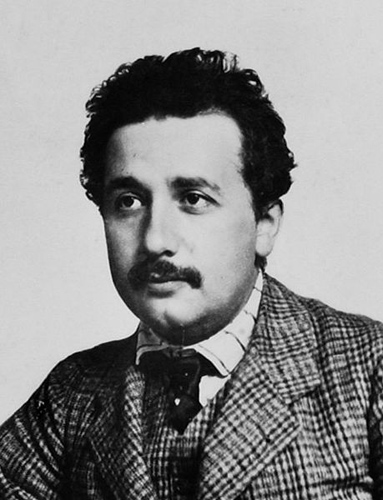
Albert Einstein
(BD)1879–1955
(O/A)Was a German theoretical physicist, philosopher and author.
(F)His family were non-observant Jews, who sent Albert to a Catholic elementary school
In 1929, Einstein told Rabbi Herbert S. Goldstein "I believe in Spinoza's God, who reveals Himself in the lawful harmony of the world, not in a God Who concerns Himself with the fate and the doings of mankind."
In a 1954 letter, he wrote, "I do not believe in a personal God and I have never denied this but have expressed it clearly.”
In a letter to philosopher Erik Gutkind, Einstein remarked, "The word God is for me nothing more than the expression and product of human weakness, the Bible a collection of honorable, but still purely primitive, legends which are nevertheless pretty childish.”
(LF)In the period before World War II, Albert Einstein was so well-known in America that he would be stopped on the street by people wanting him to explain "that theory." He finally figured out a way to handle the incessant inquiries. He told his inquirers "Pardon me, sorry! Always I am mistaken for Professor Einstein."
(Q)After World War II, as enmity between former allies became a serious issue, Einstein wrote, “I do not know how the third World War will be fought, but I can tell you what they will use in the Fourth – rocks!”
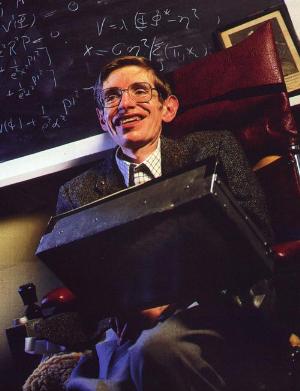
Stephen Hawking
(BD)1942-present
(O/A) A British theoretical physicist
(F)Takes an agnostic or deist approach. Believes the universe is governed by the laws of science.
(LF)Stephen Hawking is severely disabled by motor neuron disease also known as amyotrophic lateral sclerosis (or ALS)
(Q)“I have noticed even people who claim everything is predestined, and that we can do nothing to change it, look before they cross the road.”
Mahatma Gandhi
(BD)1869 – 1948
(O/A)The pre-eminent political and spiritual leader of India during the Indian independence movement.
(F)Gandhi was born a Hindu and practised Hinduism all his life, deriving most of his principles from Hinduism. As a common Hindu, he believed all religions to be equal, and rejected all efforts to convert him to a different faith.
“Hinduism as I know it entirely satisfies my soul, fills my whole being...When doubts haunt me, when disappointments stare me in the face, and when I see not one ray of light on the horizon, I turn to the Bhagavad Gita, and find a verse to comfort me; and I immediately begin to smile in the midst of overwhelming sorrow. My life has been full of tragedies and if they have not left any visible and indelible effect on me, I owe it to the teachings of the Bhagavad Gita.”
(LF)On 30 January 1948, Gandhi was fatally shot while having his nightly public walk on the grounds of the Birla Bhavan (Birla House) in New Delhi. The assassin was a Hindu nationalist with links to an extremist who held Gandhi responsible for weakening India by insisting upon a payment to Pakistan.
(Q)"You must not lose faith in humanity. Humanity is an ocean; if a few drops of the ocean are dirty, the ocean does not become dirty"
A BIG thank you to wikipedia for making this article easy for me to write.