Words of Wisdom

“One travels more usefully when alone, because he reflects more” - Thomas Jefferson

Wednesday, November 30, 2011

Reflections

As I move on in life, I constantly sense myself changing.  I don't mean this in the physical sense so much, but more mentally and emotionally.  Call it maturation if you wish.  I prefer to call it discovery.  It's as if every so often I look back at myself and my actions and realize who I am now is not the person I was in the recent past.  The most startling realization is that recent past does not mean 3 years ago or even 1 year.  I can trace a significant change in composure or thought down to months ago.  It's as if I'm standing in a room with mirrors on both sides of the wall, creating a never-ending cascade of pseudo-me's that carry my physical appearance yet have different individual assessments of this world and my place in it.

I think one of the first times I felt this way was during my transition from Christianity to atheism.  I had encountered a new way of thinking about the world and was excited to share it with my friends and anyone who would listen.  Boundaries had fallen that were kept in place by my acceptance that a god was necessary for this world to exist, such an idea I had never thought of questioning until then.  I could now view the world through glasses that were not smeared by a layer of fog that had been my religion.  However, I was still wearing glasses.

Not these kind of filters....
And I didn't know it then.  I didn't know that my perception of the world was still being obstructed by my thoughts and other beliefs that I held.  Well, hold on a second.  Of course I understood that these "filters" probably existed, but I didn't know what they were or how to tackle them.  Cue life.  It didn't take long for these filters to become apparent.  One by one they appeared, each having a unique impact on me.  The way I handled each of them was unique too, ranging from indifference to fear to acceptance.  Although, that's not to say that I've succeed in defeating all of my known filters and apprehensions.  In fact, I readily admit that I am still plagued by them.  They pop up everywhere in my life and some are harder to get rid of than others.  And I'm still discovering more of them!

So where does that leave me?  Am I to accept that I am forever doomed to drown in a sea of my apprehensions.  Nope. So, I've decided to swim.  What would life be like without any struggles?  Certainly nothing that could elicit the emotions that we've come to let define our human existence.  But enough of that.  The weights that try to pull me down into the abyss are not what I wanted to write this post about.  I want to write about the gasps of air, the uplifting moments of realization, that I have experienced.

Most of you will have experienced them too.  The intense feelings associated with friendship and with loss.  The embrace of a lover and the consumption that is lust.  The rush of accomplishment and the drag of laziness.  Wondering if you'll make it to the end of the year with crushing finances and ominous deadlines.

Indeed, over the past year I have gone through many moments of realization and I've let them consume my life.  In fact, many of them became my life for various amounts of time.  Perhaps that is what it means to live; to let people and ideas become a part of you.  A process so fluid and seamless that I didn't even realize it till now.  And yes, it seems obvious as I write this.  Many of you will think it is obvious and you are justified in saying so.  But I think that we often forget this as we go through our lives, performing the daily activities that constitute our existence.  Those daily actions often become our existence and we forget what it means to actually live.  That is what this previous year has shown me.

While I could write about my individual episodes of realization, I am currently consumed by another idea and would much rather share that with you instead.  It's a simple idea really.  Though it takes the right frame of mind to truly understand it and implement it in your life.  What is it you say?  Well, you'll have to read my next post to find out.

It feels good to be back at the blog.  I know I've let it sit idle for a long time, but hopefully this will mark the beginning of more to come.

Tuesday, May 3, 2011

When the Minority Rules the Majority

On Monday May 2nd 2011, Canada went to the ballot box. The results of the election will haunt Canadians for years to come. The Conservative party claimed a landslide victory, gaining a majority of 167 seats in the House of Commons. The NDP, riding their "Orange Wave" followed up second with 102 seats in the 308 member body, greatly increasing their presence from the 37 seats they had won during the 2008 election.

Many people will tell you that Canada didn't want this election. I'm here to tell you that Canada desperately wanted this election and was robbed of its choice by an unfair electoral system. Stephen Harper's minority Conservative government had fallen just a month before due to being found in "contempt of parliament" for its ongoing refusal to supply the opposition with details of proposed bills and their cost estimates. The timing was perfect for a renewal of trust in the Canadian government.

So if things were so bad under the minority Conservative government, how did we get here. First, the Canadian voting system must be understood. When Canadians go to the polls, they vote for a MP that will represent their particular riding. The federal party with the most MP's gets the first chance to form the Government of Canada. This is known as the "first past the post" approach. The party with the most seats will go to the Governor General of Canada and ask to form a government. However, if this party does not hold a majority of seats in the House, then the Official Opposition (the party with the second-most amount of seats) can also try to form the government with the assistance of other opposition parties, effectively forming a coalition.

http://www.cbc.ca/news/politics/canadavotes2011/
What also must be noted is that Canada is not a two-party country. We have FIVE federal parties (four if you don't count the Bloc Quebecois, which I and most Canadians don't) consisting of the Conservatives, the Liberals, the NDP, the Green Party and the Bloc Quebecois (BQ). Unfortunately, the playing field is not balanced as there is only one "Right" party - Conservatives, one "Center" party - the Liberals, and three "Left" parties - the NDP, Green Party and the BQ. What this results in is a catastrophic split of the vote.

This is how the Conservatives were able to win a majority of seats while only garnering 39.62% of the vote. The center-left parties took the majority of the popular vote and none of them were left with enough support to take first place. This is outrageous!! How dare a political party with not even 40% of the vote be allowed to govern without check and balance, the country that we live in. Unfortunately, the situation is even worse than most know.

While Prime Minister under the last minority Conservative government, Harper appointed 38 Conservative representatives to the Senate and in doing so, sealed his control over Canadian politics. The Conservatives now have 52 Senators over the Liberals 46, giving Harper unprecedented control of what legislation gets passed in the senate. Power that Harper used to defeat an NDP Climate Change Bill that had passed in the House of Commons.

So now with a majority in the House and a majority in the Senate Harper controls almost every facet of Canadian politics. Adding insult to injury will be the retirement of the current Auditor General Sheila Fraser. The auditor general conducts audits of the federal government, holding them accountable for their actions. Later this year, Stephen Harper will now have the chance to appoint an Auditor General who will turn a blind eye to his misdeeds. He surely has gained control over everything. Just as a tidbit, our current Governor General, David Johnston was also appointed by Stephen Harper.

So how to fix this terrible mess we're in. Unfortunately, we can't. At least not conceivably in the next four years. As the Conservatives have a majority, forcing a vote of non-confidence (which is how governments in Canada are toppled) is definitely out of the question. This leaves our next fixed election which would take place on October 19, 2015. Over four years of majority Conservative rule with the NDP powerless to stop Harper will do terrible things to our country. The corporate tax rate will be cut to an insanely low level of 15%. The public Health Care system we treasure will slowly be transitioned to a two-tier system of public and private. The focus of military patrol in the Arctic to "protect our resources" will suck up billions of dollars. New prisons will be built in a U.S. style attempt to combat crime and the the freedom of the internet as we know it will be infringed upon. I won't even mention attempts of restricting abortion or gay rights that some of Harper's party will no doubt try to accomplish (Yes I know Harper said he wouldn't revisit these issues but in politics, everything is fair game.).

So fast forward to October 19, 2015. If the center-left voters of Canada wish to take their government back, what must be accomplished? As I see it, there are two options.

1. Change the Electoral/Voting system

2. Unite the Center-Left

We have too many choices in an electoral system that doesn't reward choice. The Left needs to unite or the game needs to change. In regards to changing the voting process, I propose a "Ranked Choice Voting" system. Here, the voter lists their chosen candidates in the order of preference. If the candidate of first choice does not secure the majority vote in their riding, then the voter's ballot gets counted toward the candidate of second choice. What this does is to ensure that the winning candidate has a majority of support from the community. In practical terms, it would cripple the Conservative's choke hold on our government.

In order to illustrate this concept, I will take the Ontario riding of Kenora as an example. Conservative Greg Rickford won that riding with 46.85% of the vote. The NDP next at 28.18%, Liberals at 21.8 and the Green party at 2.58%. This means that 51.56% of those polled voted for a party of the center or the left. If the "Ranked Choice Voting" system were in effect then those who voted Green and Liberal as their first choice could have their votes switched to NDP, snatching the seat away from the Conservatives.

I took a look at the poll numbers across the country and if such a system were implemented, there would be a total of 51 possible seat changes from Conservative control to either Liberal or NDP control.

The number of seat changes (from Conservative to Liberal/NDP) in each province are as follows:

Yukon - 1
Western Arctic (Northwest Territories) - 0
Nunavut - 1
British Columbia - 6
Alberta - 1
Saskatchewan - 3
Manitoba - 2
Ontario - 27 (3 in the North, 24 in the South)
Quebec - 4
Newfoundland and Labrador - 1
New Brunswick - 3
PEI - 0
Nova Scotia - 2

So in effect the Conservatives would be reduced to a total of 116 seats (assuming all the listed votes went to Liberals or NDP). This is a way lower number than the current 167 seats they enjoy.

Same name of the UK party
If such a system (or one like it) is not put in place by the next election then the only hope is for the Liberals and the NDP (perhaps with the support of the Greens) to form a new party which I will dub the "Liberal Democrats". Yes there will be difficulties. Yes, there will have to be compromises. But the center-left will claim victory.

This is how the 60% of Canadians who didn't vote for Stephen Harper will have their vengeance.

So how about the immediate future. Well for starters, hardcore Liberal supporters can stop with their attacks on the NDP. Lets be grownups here. The Liberals were handed a crushing defeat because a majority of left-leaning voters saw promise in Jack Layton and the NDP. It also doesn't help that the Conservatives were able to smear your leader, Michael Ignatieff, as an American who only came back to Canada for himself. I'm not saying it's true, I'm just saying they were successful attacks. So ease up on the NDP and support them. Jack Layton's job will be an almost impossible one to do as they are up against a Conservative majority. From here on in, comments about NDP inexperience and the "unrealisticness of their platform" must stop. Lets work together for a united Canada, not a divided one.

Today a new era in Canadian politics has begun. I'm not happy with it. Sixty percent of Canadians are not happy with it, but it is here to stay none the less. If yesterday was your first chance to cast your vote and you were one of the many who were left disappointed on election night, then do not despair. You will have your chance again. And when it comes around, come out in full force and be ready to take your country back.

Click to Digg!!

Saturday, November 20, 2010

Do Not Cockk!!


Found in the hallway of my university during some renovations.
Need I say anything else...

Click to Digg!!

Friday, August 6, 2010

Blink Pixel Blink!

It is my honour to introduce you to the newest Gaming Blog on the block, Blink Pixel Blink! What does this blog have to offer that is different than all the other gaming blogs you ask? Well for one the author is Italian! (not really surprising...those Italians love their games) He's also an avid gamer and my best friend. His insights on the video game industry and culture are ballin' and his knowledge is astoundin'! So who better than to describe his blog than the man himself:


"Blink, pixel, blink was created by some Italian guy on July 18th, 2010, instead of working on a philosophy paper which was due the following morning. He started BPB for one simple reason: he knows more s*** about games then you do and he wants to prove it. His goal is to write concise reviews for those who just want to know if a game is worth playing and more in-depth reviews for those without girlfriends (and that’s most of you) who take up precious gaming time. He will also pump out articles like it’s his job (which he wishes it was) and probably make multiple references to Calabria or some other thing from his homeland.

What makes this guy so qualified you ask? First of all, stop asking so many questions and swallow the Cheetos before your talk..."

And that's just a taste of what he is gonna bring to the table (your computer screen)! Also versed in the language of philosophy, his article Fatties and Fallacies is a shout out to all his gaming brethren and those who would oppose them. Not only is he a master player (of the games) he is also the synth player for the band Maraday Park! They've made some sick tunes so definitely check them out.

So check out Blink Pixel Blink, you just might learn something!

Also join his Facebook Group and follow him on Twitter @blinkpixelblink

Monday, August 2, 2010

Why is Snow White?

Yes! The burning (cooling?) question I know you've all been asking since you first set your eyes on the magical powdery stuff...why is snow white? It was on my way up to my geology summer job that I stumbled upon this thought. As I drove further north towards Armstrong Ontario (and then past it), I realized that there was snow on the sides of the road. But this wasn't December or even March. This was May! But anyway, it was then that I figured that I should find out why snow is white.

First, we should understand why things have colour in the first place. What we perceive as visible light is actually a combination of many different frequencies of light. Our eyes take in these differing frequencies and interpret them as colours. Where do these frequencies come from? Well, particles in objects vibrate in response to energy. Depending on the frequency of the energy, each object will have a vibration frequency which in turn determines the colour emitted. Also, the particles involved absorb a certain amount of light energy which is then absorbed as heat. As a consequence, certain objects can absorb certain frequencies of light more than others.

What happens next to the light frequencies that are not absorbed differs depending on the particles involved. In one case, the photons (light energy) emitted continue to pass through the particles of a material, resulting in a transparent object. In another case, the photons are re-emitted out of the material, so no light (or very little) passes through, resulting in an opaque object. The colour that we see is a combination of the light energy that the particles didn't absorb.

So now back to snow. We know that snow is just frozen water (ice) which is actually translucent. This leads us to conclude that the photons don't actually pass directly through the material, but actually change direction due to the particles of the material. This is due to interaction of the light photons with the molecular structure of the ice. This interaction alters the photon's path and it exits in a direction all together different than which it entered.

Since snow is just a group of individual ice crystals positioned together, the effect mentioned above occurs on a large scale. When light enters an ice crystal, its direction is altered and it goes through another ice crystal. This continues to happen until the light is bounced right out of the snow. Since it does this to every light frequency, all colours of light are shot back out. When all the colours of the visible spectrum are combined (which is what has occurred here with the ice crystals), we end up seeing the colour "white". Hence, snow! However, if we were to look at the individual ice crystals, we would see differing colours.

And there you have it! You now know why snow is white, and if you can connect the dots, why objects are the colours that they are.

Click to digg this!!

Friday, July 30, 2010

Get to know a Mineral: Molybdenite

About a week ago, I happened upon a new mineral on the property I am working on. We were cutting channel samples when a purplish liquid ran out of the rock cut and upon further inspection, I found silverish goo in the rock. I did not know it at the time, but we had found Molybdenite. So I decided to make it the topic of today's entry.

Molybdenite or "Molly" (as it is affectionately called by geologists) is a soft metallic mineral that is often confused with graphite. In fact, the two minerals can appear so similar that their streaks are often the only way to tell the difference. And if that fails, then it falls to the comparison of density, molybdenite being the denser of the two.

The chemical formula of "Molly" is MoS, and because of its layered structure it has a lubricating effect. Consisting of a sheet of molybdenum atoms squeezed between sheets of sulfur atoms, the atomic structure of molybdenite balances strong Mo-S bonds with weak sulfur bonds between layers. This results in effortless slippage and cleavage planes.

Occurring in high temperature hydrothermal ore deposits, molybdenite is associated with pyrite, quartz and fluorite (to name a few). The element rhenium readily substitutes for molybdenum which can result in a varying structure. Tracing the radioactive isotope rhenium-187 and the daughter isotope osmium-187 allows for geo-chronolgic dating, which is useful for determining dates of deposition and origin.

The main element in "molly" is Molybdenum (Mo) and it has a rather interesting history. It previously held the name molybdena and was often confused with both graphite and galena. It was thought that it contained lead and that is where it gets its name, molybdos (ancient Greek for lead). It was only in 1778 that it was discovered to be its own element and three years later it was successfully isolated using carbon and linseed oil. Reportedly, the alloying of molybdenum with steel was found to occur in one 14th century Japanese sword. Unfortunately, this art was never used widely and was subsequently lost (hence the lack of molybdenum-sword wielding ninjas).

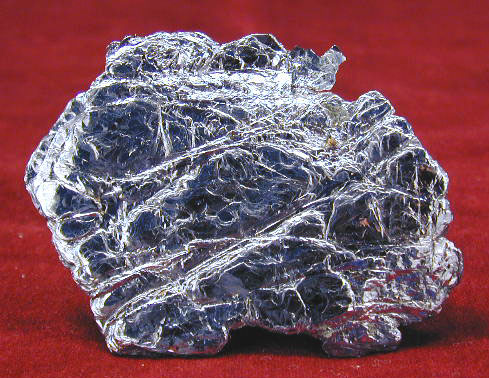
Obviously not Molly...
In World War I, the British replaced the manganese steel plating on their tanks with molybdenum steel plating, which allowed for higher speed, increased maneuverability and greater protection (despite being thinner). Current uses for molybdenum include being used as an adhesive between enamels and metals, as a fertilizer for some plants (including cauliflower) and in biological staining procedures.

Listed on the London Metal Exchange, molybdenum has a value of about $30,000/tonne (as of August 2009). Due to increased demand, it reached a peak of $103,000/tonne in June of 2005! It is the 54th most abundant element in the crust of the Earth and 42nd in the Universe. It was even discovered on the Moon by a Russian space mission.

Crystal System: Hexagonal
Cleavage: Perfect [0001]
Streak: bluish grey
Hardness:1-1.5
Luster: Metallic

Also Get to Know:
Molybdenite
Cummingtonite
Garnet

Click to digg this!!

Wednesday, July 28, 2010

My Theory of Relative Existence

Trying to understand the world is not an easy thing to do. Trying to come up with reasons for the things you do is even harder. Thinking about this, I realize that we have no solid reasons for why we do things, other than the obvious "to survive" and "because it feels good". I guess I should explain myself better.

Biologically, we know why we need things like food and love, and physically we know why we succumb to forces like gravity and momentum. What I am thinking of is how we interact with other people, other organisms and our environment. Why, for example, do we hold domesticated animals such as cats and dogs in higher esteem compared to wild animals like boars and wolves? Why do we feel the need to hold doors open for others or even be polite for that matter? Why do we swat insects but cringe at the idea of the mass culling of seals? Of course I am generalizing. I do not pretend to know exactly how every single human thinks, but I have confidence that I have the general idea.

It's like the game you might have played as a child. You would ask your parents a question and they would give you an answer. You then tack on the word "why" to their answer and the game continues until you're blue in the face or your parents lose their patience. I was trying to play this game, but I have chosen to stop at 1 or 2 whys. And now I am asking you to play the game with me. For anyone will notice that the answers we come to are not always the same.

So, when I played this game, I came up with something that scratched the surface of the first why. I like to call it my Theory of Relative Existence.

In my theory, all of our interactions occur between the Five Spheres of Existence. They are Mind, Human, Animal, Environment and Universe. There are probably an infinite number of spheres but I believe these five to be the most important. Everyday thoughts and actions all take place within these spheres, whether we realize it or not. Some people only recognize the existence of a few of these spheres but unknowingly act within all of them. These spheres are the basis for the justification of our actions and in turn, how we view the importance or relativity of these spheres will decide how we act in relation to anything in our world.

With an understanding of our place within each of these spheres, we can begin to peel back the layer of "why" that shrouds our lives. We must too understand that while our relationship with each sphere is of our choosing, there are factors that guide these choices. These factors can be hereditary, as in genes passing down traits from generation to generation. They are also found in our interactions with our parents and friends. Indeed, while our genes lay down a framework for how we will act and respond to the physical world, it is our interactions that will most heavily shape us. Furthermore, the application of science (deduction and reasoning) is necessary for developing and understanding our relationships with the spheres.

So let me take you into these spheres and try to explain my understanding of them.

First, we need a pivot. A central point for all the spheres to rotate around, and that is you. Essentially, the pivot is whoever is in control and at this time, it is you and I who are taking this journey. I would also like to explore the ideas of good and bad in the context of each sphere. So on we go!

The first of the five is the "Sphere of the Mind". As we are conscious beings, capable of thought and rationality, we must confront what makes us think. Different people have looked at various aspects of the mind in order to understand it (Jung, Freud) and modern science has allowed us a glimpse into the inner workings of our brains. Above all, we must appreciate the complexity of our mind and be aware that it can play tricks on us. The mind is where we can be alone to think and go over occurrences past, present and future. It is here where biological settings are hardwired into our brains from years of evolution and variation. Processes like "Fight or Flight" or "share or not share" can be found here and to truly understand why we do things, the mind is the most important sphere to decipher. Unfortunately, our brains are not yet fully understood and it would be foolish for me to try to explain what we do know. Here is where the ideas of good and bad share both biological and environmental foundations. Biological in the sense of evolution (eg: protect family, share food) and environmental in the sense of interactions with people (eg: greetings, etiquette). The mind is also where clashes occur between the two foundations; for example, the issue of sex. While our minds hold the stance that sex is good, normal and something that should be practiced, most societies regard sexual relations as a taboo and as something that should be kept in the shadows. An understanding of the mind is essential for realizing why we think in certain ways and in turn, why we interact with others the way we do.

Onto the next level, the Sphere of Human Interaction. This sphere contains any and all issues that arise when humans interact with each other. Love, work, school, sports, lifestyles, alcohol and drug use are just a few of what can be experienced. The position of women in society is another issue that is dealt with in this sphere, and since women were only recognized as "persons" in Canada around 1929, it is still a relevant topic today. In understanding this sphere, we must know that racism, sexism and any other bad "-isms" are judgmental actions and their reasoning unfounded. Equality and patience are needed here. A bit of advice courtesy of Jesus: "Do unto others as you would have them do unto you." He may not have been the first person to run with this idea, but he sure did his part to share it (putting aside the whole "Son of God" thing here). The issue of abortion also plays into this sphere. As the preservation of life (especially human life) is top priority for pretty much everyone, it is hard to come to a decision about abortion. Should the present life of the mother take precedence over the possible future life of the baby? Are grey areas (rape, incest) acceptable reasons for an abortion? My opinion is yes for both questions.  Good and Bad in the Human Sphere often follow empathy (identifying with the feelings and motives of another). How we relate to each other will alter our attitudes (and in turn societies') to certain ideas and practices. As we are the dominant species on this planet, and with no other life forms to "talk to" (yet), more people need to start rethinking the way they interact in this sphere. The shear amount of wars and violent disputes ought to suffice as evidence.

Continue to page 2